

After years and multiple unrealised plans. I had finally arrived at the Golden Temple, Amritsar, India. It lies at the north-western borders of the country in the prosperous state of Punjab, and is a stone-throw’s distance from Pakistan and is one of the world’s most visited religious sites.
A short flight from the capital Delhi, and Amritsar offers an eclectic balance of spirituality, gastronomy and a bit of dark history, bursting with tales of bravado, sacrifice and valour. An oasis of peacefulness in the middle of a bustling historic city, the Golden Temple – the most sacred site of the Sikhs, ranks among the topmost spiritual journeys in the subcontinent.
It is early dawn, but the footfall implies otherwise. The narrow streets of this medieval city – never designed for new age SUVs – have already choked, while electric tuk-tuks try to justify their existence by sneaking impossibly through the narrowest corners.
Even before I could get out of my tuk-tuk, peddlers have sold me a saffron headscarf and a fridge magnet, while I have to push back on plastic jerricans to carry forth precious water from the sarovar (Lake).
 How can I refuse a jerrican, alleges a vendor – it is the very sacred lake that has given its name to the city (Amritsar means the lake of nectar); by refusing to carry its waters, I have pushed back on the most pristine memories of this place, almost committing sacrilege before my pilgrimage has begun. But I do not argue about intangible memories versus tangible H20 molecules. Every pilgrim’s progress is different, the lowest common denominator of which is definitely neither water nor its crucible.
The cars continue to honk, the turbaned Sikhs everywhere speak in a mellifluent language making me wonder if they are squabbling, or discussing collaborative techniques to resolve the logjams. I am carried by the sea of humanity around me, and without difficulty, am able to find my way around – to submit my slippers, wash my hands and feet, walk through troughs of clean water, get scolded for not covering my head yet.
By the time I have tied my saffron headscarf, I have moved further to a narrow staircase that leads downward. It is then, after all these distractions – as if deliberately planted to sidetrack the purpose of the visit – that I see the first glint of gold. I stop on my way and look ahead. After the eyes have succumbed to the pale white of marble everywhere – from the stairs, to the corridors, to the shoe stores and the water troughs – for the first time, a different colour seems to break the monotony of the blanched boundaries.
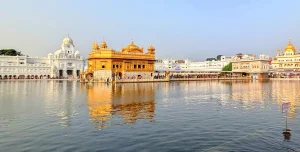
I walk along – a poet cannot ponder when persistent pilgrims push him from behind. But as I walk down the stairs, the full immensity of the Golden Temple gradually reveals itself, bit by bit, one dome after another as the morning sun also begins to sparkle, as if creating a crescendo and parting the curtains to the play called, ‘Welcome to the Golden Temple.’ Waheguru, I had finally made it, or should I say, I was finally allowed into the most sacred sanctum of the Sikhs, Sri Harmandir Sahib at Amritsar.
Where is the Golden Temple?
The north-western corner of India (present day Punjab) was the birthplace of Sikhism, a religion founded by Guru Nanak in the 15th Century. Following the birth of the religion came a line of Gurus – teacher, who shaped its history: Guru Ram Das dug the sacred lake, and Guru Arjan Dev later sanctified the shrine, establishing it as the spiritual heart of the faith.
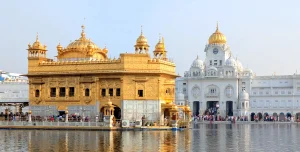
Formally known as Harmandir Sahib, the temple stood as a symbol of resilience through centuries of conflict until it was rebuilt by Maharaja Ranjit Singh (founder of the Sikh Empire and the last owner of the Kohinoor diamond before it was taken by the British) and wrapped with gold in the early 19th century. Today, with over 100,000 visitors daily, it is the most sacred pilgrim centre for the Sikhs, besides being one of the most visited spiritual destinations in India and the world. While it has been on the tentative list for UNESCO world heritage sites since 2004, the Sikh leadership has opposed a formal application to prevent over-tourism in what is their spiritual epicentre.
Beyond the Golden Triangle
While a lot of international tourists visit India’s culturally vibrant Golden Triangle – Delhi, Agra, Jaipur, they miss out on Amritsar which is an hour-long flight from the national capital. Of course, Amritsar is not as star-struck as any of the three cities – these are historically and architecturally way denser – nonetheless, the Golden Temple is unique, and while Amritsar has a lot of other stars – and a crackling gourmet scene – the golden temple alone deserves to extend the tourism Triangle to a Quadrilateral.
Talking of Agra, as I was descending down the narrow stairs and getting the first glimpse of the resplendent temple at Amritsar, I found the contrast of everlasting white and sudden gold quite exhilarating. It immediately reminded me of another colourful contrast – from deep-red, continuously running red sandstone everywhere on its periphery to a sudden transition to a cool, composed, tranquil white of the grandeur that is the Taj Mahal. I found the similarity of captivation through the contrasting of colours very poetic – as if the initial walk was making for a deliberately slow preface ahead of the main story. Two very different edifices, two purposes, religions, locations – the same play of colours to set the preamble! Two amazing jewels in must-see India.
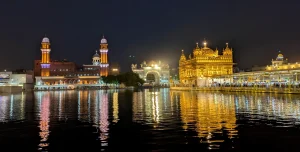
The shrine and the Sarovar
As you enter the temple complex, you will realise you have to climb stairs down – for the Golden Temple stands on a lake at a much lower elevation compared to the surrounding ground. While most places of worship stand atop the tallest crests, rising on grand foundations so they look commanding, the Golden Temple is the exact opposite. Guru Arjan Dev designed Sri Harmandir Sahib lower than its surroundings – Visitors must step down, symbolizing the shedding of ego and the practice of humility before entering the divine space.
As you step down, you will find the temple standing at the centre of a rectangular lake – the Amrit Sarovar or Lake of Nectar (and hence the moniker, Amritsar). While the surrounding marble walkway (parikrama) offers a spacious and peaceful stroll, the bridge leading into the main sanctum is a different story. Inside this inner shrine rests the Guru Granth Sahib, the holy scripture declared by the tenth human Guru in 1708 to be the eternal, living Guru of the Sikhs. Because it is revered as a living monarch, the text is treated with absolute royal protocol—resting on a throne under a canopy and being fanned with a ceremonial whisk.
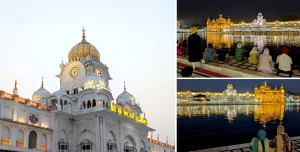
The inner sanctum is open from 3:00 AM to 10:30 PM, and during these hours, the pathway stays heavily crowded with pilgrims, often resulting in a wait time of several hours just to catch a glimpse of the holy book.
The highlight of the temple’s daily routine is the Palki Sahib ceremony, a deeply moving royal procession that transfers the scripture between the main sanctum and its resting bedroom at the Akal Takht twice a day. Occurring in the early morning around 4:30 AM and again in the evening around 10:00 PM, hundreds of devotees gather along the path to witness the event.
The holy book is carried inside a magnificent gold-and-silver palanquin adorned with fresh flowers and silk sheets. As the procession moves to the thunderous beat of a ceremonial drum (nagara) and the joyful chanting of devotional hymns, eager volunteers continuously switch out to shoulder the heavy beams, sharing the immense honour of carrying their living Guru.
A Sensory Experience
I found the perambulation around the temple very interesting. Barefoot, head-covered devotees were found in contemplation everywhere. Some were walking like me, others were seated on the banks and listening to the sombre but melodious Gurbani (musical renditions of the scriptures); a few were also taking a holy dip in the lake. Sewadars – or volunteers dressed in electric blue robes and turbans and walking with lances provided a layer of security and order.
I also happened to see a few Nihang Sikhs – the martial knights originally formed by the tenth Sikh leader, Guru Gobind Singh, in the late 17th century as an elite, vanguard military order to defend the Sikh community against the Mughals – dressed in blue robes and blue turbans.
I saw in them a timeless bridge holding together history, traditions, and that sense of pride in keeping together a small community in this one corner of the country. What was also reassuring was that entire families – across ages – were seated or walking together, the younger ones not screaming for mindless, mobile entertainment: it felt as if within this walled compound, nothing had changed – not just traditions but also expectations, mannerisms and the core focus on that one shrine on the lake, and through that, the inner shrine of life.
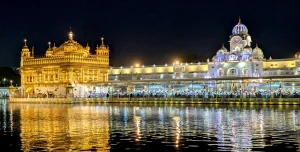
As I kept walking, I realised it was not just a visual treat but a full sensory experience that reverberated with every step you took. Beyond the striking sight of the golden sanctum, the surrounding white architecture stood tall, showcasing a magnificent fusion of traditional Indian craftsmanship and grand Indo-Islamic design principles. Besides the sea of humbled humanity, the auditory landscape floated effortlessly across the courtyard, bouncing off the walls and creating an ambient, meditative soundtrack. The experience was deeply tactile as well. Walking barefoot on the clean, smooth marble getting slightly warm with the rising sun added to the sensory experience.
Following the perambulation comes the unforgettable journey into the shrine itself. While the long queue tests your patience, the surrounding sea of humanity reminds you that everyone stands as an equal, transcending all faiths and backgrounds without discrimination. Little by little, the line inches forward in a steady pilgrim’s progress. You leave the embankment, cross the marble causeway, and step into the temple premises of the main sanctum. Once inside, you are mesmerised by the sheer devotion filling the space. Within the lavishly decorated shrine, the holy book sits at the centre while priests perform sacred rites amidst continuous, meditative singing.
After hours when you leave the sanctum, you may perhaps feel a tiny shift in yourself – someone who stood through the test, and passed through the halls of peace to perhaps not find God, but re-discover the eternal spark that prevails in each of us but often held back by the humdrum of an everyday human life. If you don’t, that’s fine as well: The sacred prasad—a warm, velvety offering rich with ghee and sugar—waits just outside to delight your taste buds and ground you in the sweetness of the moment.
Day and Night
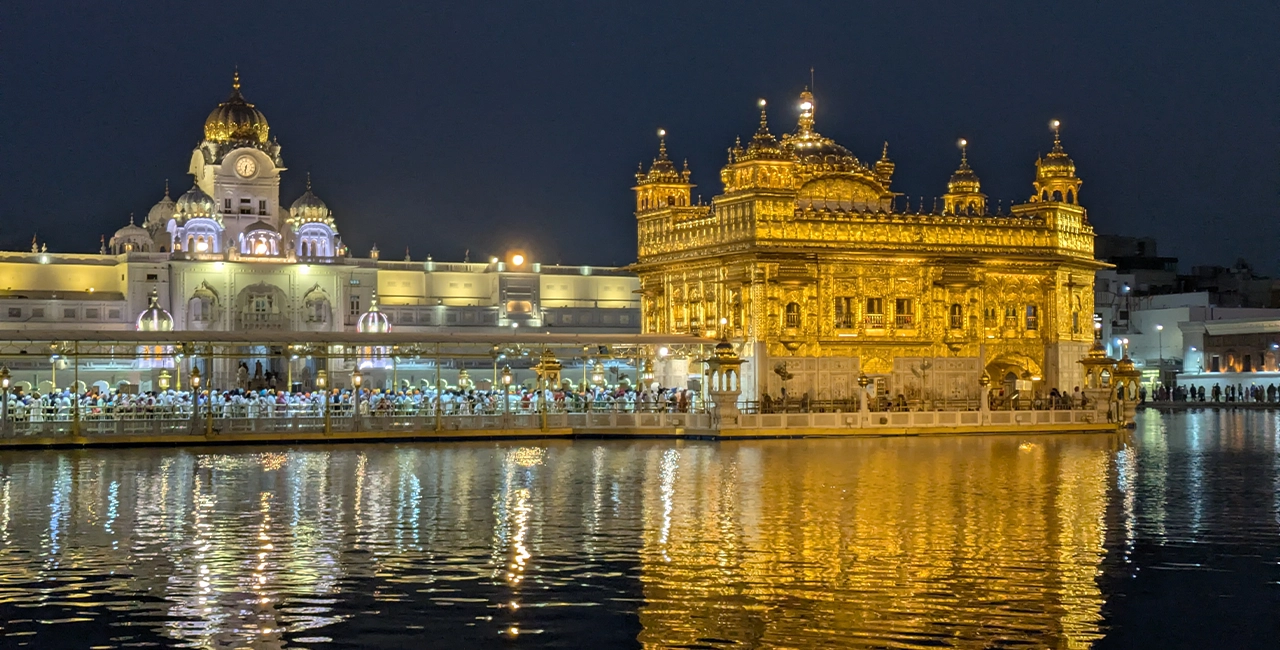
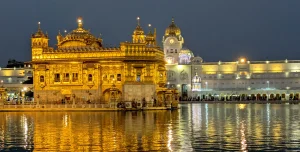
The Golden Temple has its own allure – sometimes, one visit may not be enough. The great thing is the complex is open 24 hours a day and is free to visit. If you can, you should time your visit twice, once during the day to see the golden décor under blue skies. And then, again, at night when the temple lights up after dusk in the dark and becomes a captivation with its striking lights and shimmering reflections.
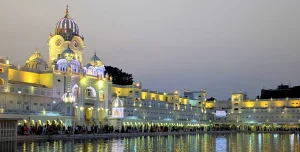
I visited the temple again at dusk – warm golden lights focused on the temple amplifies its glimmer and glow, while the shimmering reflections feel ethereal. Not just the temple, but all the surrounding buildings in the complex are alit with different colours in pastel tones – which under the dark skies, create a symphony of colours swirling around the golden epicentre.
It may feel a bit ostentatious, but it is perhaps a bridge that tests you – just like the causeway that checks your patience, tests your limits and filters out the tourists from the true seekers, perhaps the entire set up is a portal, a gateway, a filter. Its purpose is then not to mesmerise you, rather to draw you to the threshold and ask you if you have it in you to make it across the bridge of prayers, promises and pilgrimage.
If you go:
- Amritsar is well connected to all major cities of India, with regular flights to Delhi and Mumbai
- Plan your trip to not coincide with public holidays or special Sikh ceremonies when the crowds swell in numbers
- When to go: The best time to visit north India is October – November (post monsoon) and February – March (late winter and spring). December-January is good time as well but may get too cold and foggy.
- Where to stay: Amritsar has an abundance of luxury stays with Ramada Wydham being the closest stay to the Golden Temple. Taj Swarna, Courtyard by Mariott, Hyatt, Holiday Inn are among many other luxury options in the city, offering the best in Indian hospitality. There are many other options across budgets around the Golden Temple, or closer to the Airport.
- The Golden Temple is wheelchair accessible and provides wheelchairs for disabled travellers – you will need to carry your identity proof to avail its services
- Amritsar is not just the Golden Temple, other attractions include the Jallianwala Bagh memorial, the Wagah Border, the Durgiana temple and places where you can sample rural Punjabi life.

Ayan Adak is a business consultant by profession and loves travelling, writing and photography in his spare time.